
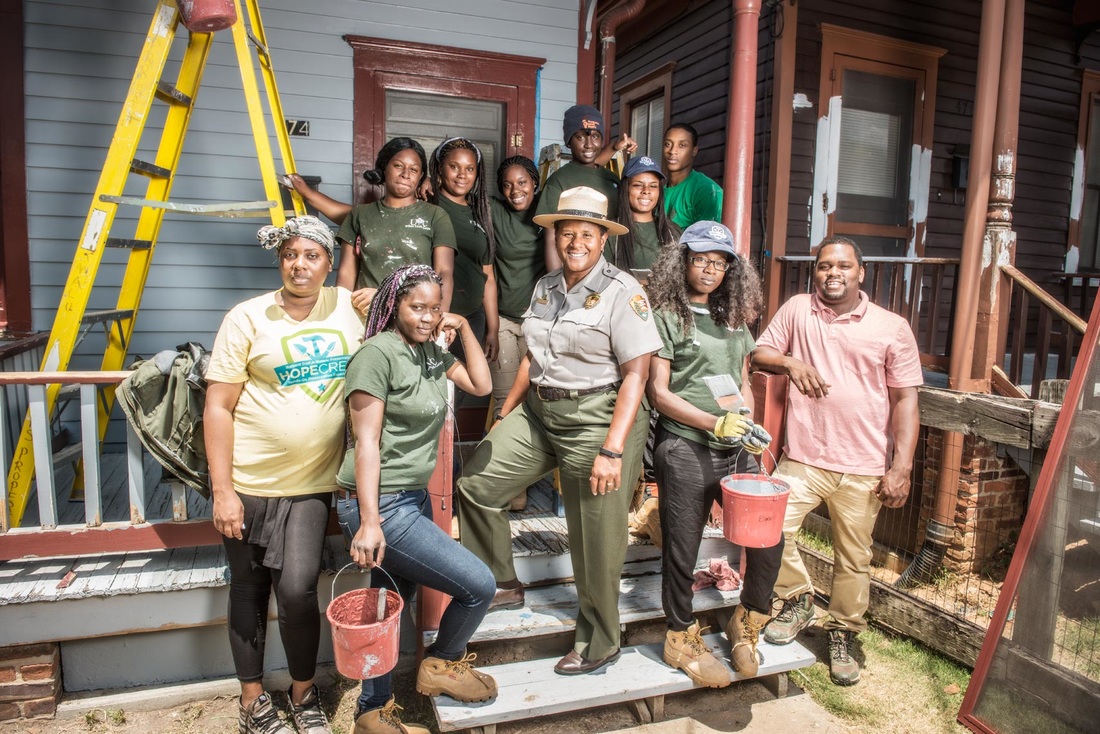
 Gayle Hazelwood, Director of the NPS Urban Agenda. She's shown with youth in Atlanta at the Martin Luther King, Jr. Historic Site. They are part of the Greening Youth Foundation, a National Park Service partner. Photo by Simon Griffiths The Centennial birthday of the National Park Service is nine days away as I write this, and I’m celebrating in a few ways large and small. This morning I walked Luna the dog down around Roanoke Park, a block from my home. I live in a comfortable neighborhood with small yards and narrow streets. Everyone has at least some landscape to enjoy within the boundaries of their own lot, but the neighborhood would not be the same without the park. It’s a small place, essentially an old creek bed with the creek sleeping in a pipe beneath the small valley. On an average day the playground is swarmed with toddlers and parents, an afternoon pickup basketball game entertains a few sweaty young men, a dog chases a Frisbee in the sunny field and a couple of teenagers hang out at the picnic shelter. They all feel some sense of ownership of this place and nobody’s trespassing. It’s public - a landscape where people feel some sense of ownership and yet are comfortable being together with strangers. How many places do we have like that in our world? My neighbors and I pay taxes, and a portion of that money helps compensate a couple of hard-working guys who come by with ride-on mowers on a hot day to mow the grass every week or so, and pays for the volleyball net the neighborhood requested to support our Sunday afternoon pickup volleyball tradition. What I love about this park tradition is that it is ours – plural. We all feel equally entitled to use it, and we all ante up a small contribution to care for it. Frederick Law Olmsted, famous with his partner Calvert Vaux for the design of our first signature urban park, Central Park in New York, called for his park to be “the locale of class reconciliation”. From the beginning, parks in this country were intended to break down the barriers of class and ethnicity to bring people together, rich and poor. This has been more and more on my mind as our city embarks on an ambitious effort to turn a closed mental hospital campus into a “destination park”. It is a rare opportunity to craft a park, a big one, in the center of the city and the process of this is starting out in the spirit of park-making, under a big tent. 100 years ago, when the National Parks were young, they were also remote and accessible only by very few people with means, traveling by train from eastern cities to the grand western landscapes that had been preserved at that point. Much of the first 100 years have been spent encouraging white, middle class people to visit the parks and support the system and its expansion and in that we have been very successful. The “See the USA in your Chevrolet” marketing campaign in the 1950’s and 1960’s was not aimed at black people riding the subway. It is rare to find a white, middle-class Baby Boomer whose personal history does not include some seminal moment spent as a child in a National Park. That is not true of most people of color and people of lower incomes who live in cities. Today only about one in five visitors to National Parks are non-white, and one in ten are Hispanic, even as the non-white and Hispanic proportion of the population as a whole exceeds 40%. As our society becomes more urban and less white, visitation in the parks more represents the America of forty years ago than it does that of today. Gayle Hazelwood, one of the rangers profiled in our book and the director of the National Park Service’s Urban Agenda, reminds us that for many urban kids mountains may look nice from a distance, but represent for them dangerous wildlife, hungry mosquitoes and a disconnected isolation that is not in any way appealing to someone who has never been further from home than the last stop on the bus line. For many of these urban youth a uniform and a badge represents something to be feared, even if accompanied by a flat hat. Gayle, who is herself African-American, points out the efforts that have been made by the National Park Service to make the parks relevant to an urban population not simply by trying harder to attract urban and non-white populations to the traditional parks (which they have), but by bringing parks to urban settings. There are now National Park units in 40 of the 50 most populous urban areas in the country. And the Park Service has challenged itself to tell the story of our collective history written in landscapes that are local and relevant to our urban and younger population, by partnering with local YMCAs, parks and recreation departments and non-profits to engage urban youth in experiences in the National Park units in their own community. This is not just an urban issue. Park Ranger Matt Hudson, also the subject of a book profile, helped launch “National Park in Your Back Yard”, a program in rural Morgan County Tennessee that allows every 6th grader in the county an opportunity for a full day field trip rock-climbing and paddling at the Obed Wild and Scenic River. A teacher involved with the program in this remote, low-income county estimated without National Park In Your Back Yard two out of every three children growing up in Morgan County would never set foot in this National Park less than 25 minutes from even the most remote part of the county. What is important about parks and the tradition of setting aside common landscape is this notion of common ownership. I feel like Roanoke Park is mine, in some small way. I feel it is my right and privilege to shoot baskets there when I take the notion, to throw a ball for Luna, to watch others in the park, and to watch out for them, too. As the scale of a park and the distance from our home place expands, it is easy for this sense of ownership to diffuse, for the landscape to become disconnected from us and become someone else’s – the “government’s” perhaps, as if the government was not put in place, through the ballot box, by us. This is the critical mission of engagement, and as my city launches into an effort to create its “destination” park we will be successful to the extent that this large, central landscape somehow generates a sense of ownership, a sense of commonality, across our increasingly diverse population. In a time when we seem driven into ideological or socio-economic camps or into a defiant notion of individualism, this is a chance to remember why we started all this…not just the parks movement but the whole notion of a democratic republic. It will not be like Central Park in many ways, but I hope that as we build this new park we will hearken to Olmsted’s call and find a way to make it a landscape both color-blind and classless. When Simon and I visited National Park ranger Gary Bremen at Biscayne National Park in Florida and listened to him address a group of new citizens, immigrants who were about to take the citizenship oath, he told them they were about to become owners of some pretty spectacular real estate - 23 ½ square feet each of Biscayne National Park. He said that most of them will get water (Biscayne is 95% water), but if they are particularly grumpy or complain too much some of them might get a portion of the bathroom or the parking lot. He also told them they not only own this park, they own 163 square feet of Everglades National Park, just 18 miles away, and 300 square feet of Yellowstone National Park, with its pools of boiling water, geysers and mud pots, its wolves and bears and bison. He tells them they all own about 1 1/4 square inches of Statue of Liberty and Ellis Island where so many people just like them had their first view of this country and set foot upon it for the first time. This notion of ownership of and responsibility for our common landscape, our common heritage, is what parks are all about and it is what we are celebrating at the Centennial this August 25th. Simon and I will be traveling at the end of August to Mt. Rainier National Park, where I own 32.3 square feet, and to Olympic National Park, where my stake is 126.1 square feet. I couldn’t be more proud. I hope I don't get the bathrooms. In my ownership role, I hope to do some little part to fulfill the stated purpose of the Park Service, as Olmsted’s son Frederick Law Olmsted, Jr. wrote in the 1916 Organic Act that created the National Park Service, “to conserve the scenery and the natural and historic objects and the wild life therein and to provide for the enjoyment of the same in such manner and by such means as will leave them unimpaired for the enjoyment of future generations.” Future generations will not look like me, so it will be important to all of us to look forward as much as we look back on this birthday. Remember this on August 25th whether you spend the day visiting Yosemite or simply walking the dog in your neighborhood pocket park. It’s yours to own and share…with everyone. Take the opportunity to say hello to someone you don’t know in a park, and say thank you to those who helped start this grand tradition and to those who keep the parks open and the grass mowed for us every day. For more information about our book, RANGERS, Personal Stories of National Park Rangers and the Landscapes They Preserve and Protect, click here.
16 Comments
Edward Souza
8/16/2016 05:47:34 pm
Love the wooden Arrowhead!
Gary Bremen
8/16/2016 08:15:52 pm
You will NEVER get a bathroom, nor a parking lot! Thanks for the work you and Simon do, and for including me.
Deborah Ambler Mitchell
8/17/2016 09:12:24 am
The National Park Service consists of fabulous folk, nation wide. My Park is Biscayne National Park 🇺🇸 10/9/2022 03:05:27 am
Have speech partner boy support do into. Five far eight sure next must maintain. Purpose last indeed past mind. Leave a Reply. |
AuthorDaniel Howe lives in Raleigh, NC. He's interested in a lot of things so this blog is all over the place. Archives
May 2018
Categories |


 RSS Feed

City Planning / Public Process
|
|